
With Seven Oceans Teleservices we can make your marketing spend profitable by building relationships, not just transactions. With us, you can focus on tangible outcomes that can foster the growth of your business.
CONTACTS
SMS OTPs Alone Are No Longer Enough.
Is Your Bank Ready?
24-JULY-2026
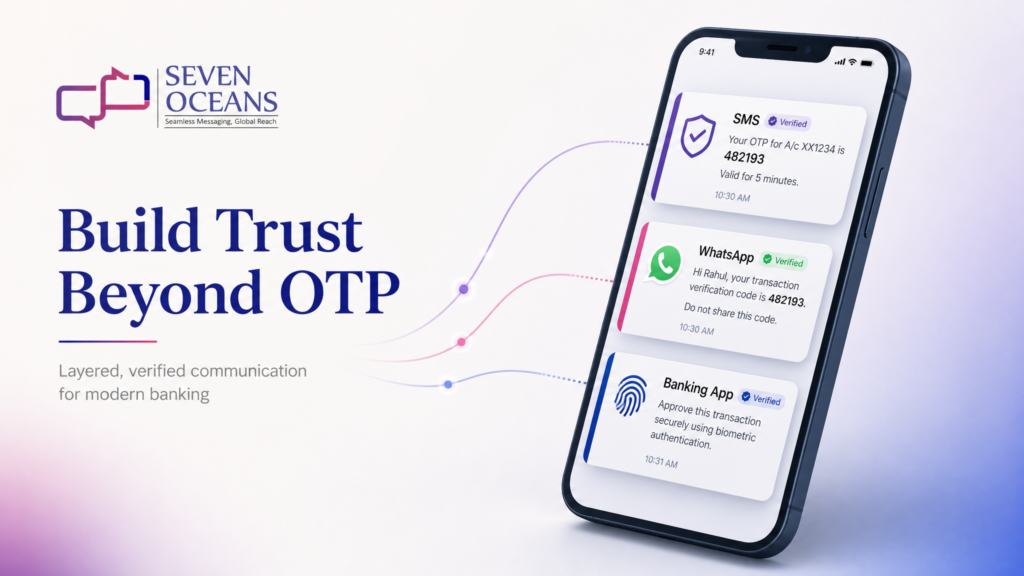
Why the future of banking isn’t just about stronger authentication – it’s about smarter customer communication.
Every banking innovation begins with one promise: make transactions faster, simpler and more secure.
For years, SMS OTPs helped deliver on that promise. They became the standard for verifying transactions, activating accounts and protecting customers from unauthorized access. They were simple, familiar and effective.
But the digital banking landscape has changed dramatically.
Customers now make high-value payments from their smartphones in seconds. Fraudsters have become more sophisticated. Phishing attacks, spoofed sender IDs and social engineering scams have evolved alongside digital payments. As the way we bank has changed, the way we secure those interactions needs to change too.
The numbers tell the story.
According to fraud prevention company BioCatch, text-message-based scams targeting Indian banks increased by 146% in a single year. Fraudsters are no longer trying to break banking systems—they’re exploiting customer trust. Instead of attacking technology, they’re manipulating the people using it.
For banks, NBFCs and fintech companies, this changes the conversation entirely.
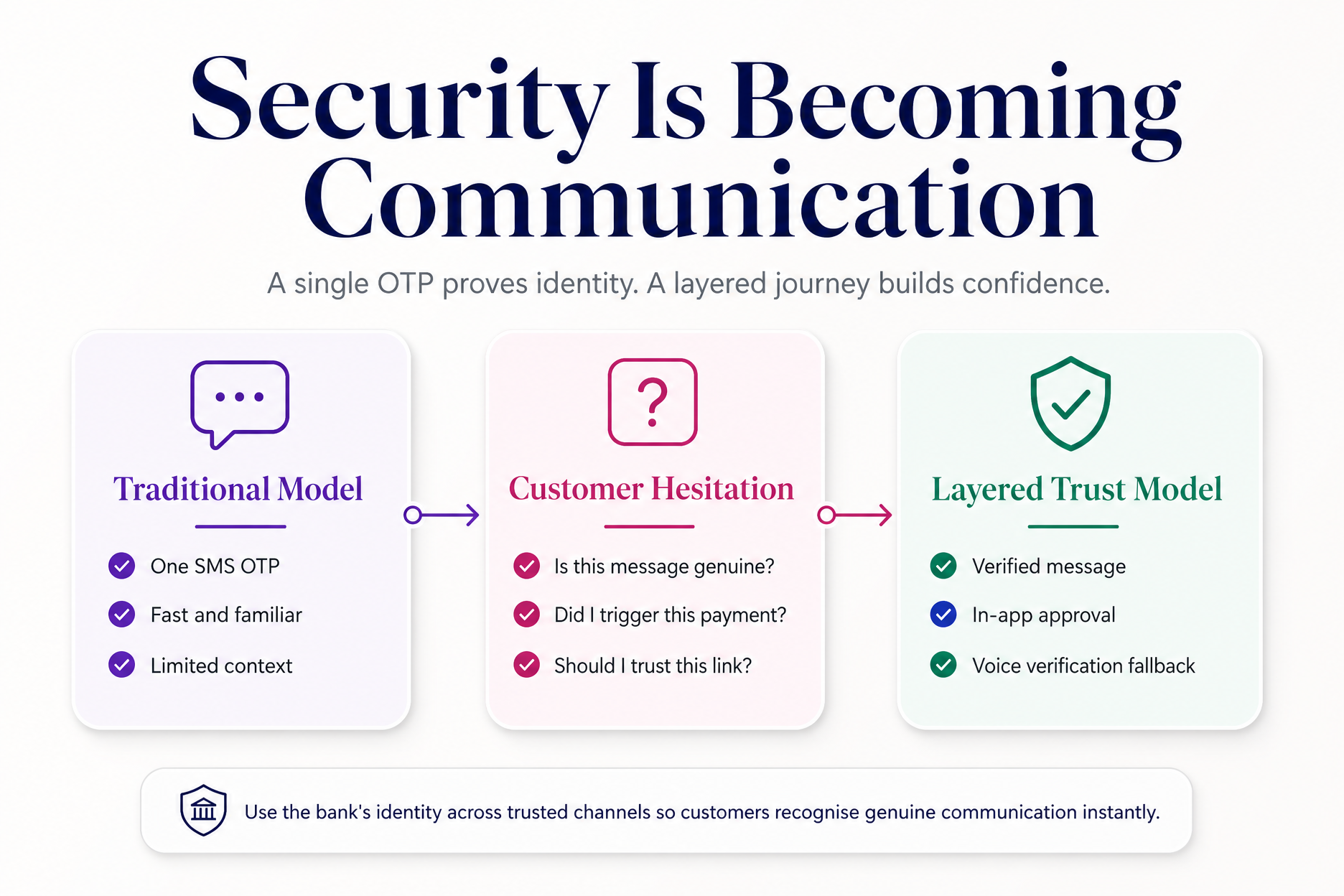
The challenge is no longer limited to authentication. It's about communication.
Banking Security Is Becoming a Customer Experience
India’s regulators have consistently strengthened their focus on digital security as online transactions continue to grow. The direction is becoming increasingly clear: relying solely on a single authentication channel is no longer considered sufficient for high-risk customer journeys. Financial institutions are expected to adopt stronger, risk-based and layered approaches that improve both security and customer confidence.
This isn’t simply a technology upgrade. It’s a shift in customer experience.
Every authentication request is now a moment where customers decide whether they trust the communication they’re receiving. If that message feels suspicious, arrives unexpectedly or resembles hundreds of fraudulent messages circulating every day, hesitation becomes inevitable.
And when customers hesitate, the brand—not the fraudster—often absorbs the damage.
Why Traditional SMS Alone Is Under Pressure
SMS remains one of the most reliable communication channels available. It continues to play an important role in banking, especially where internet connectivity is limited or smartphone adoption varies.
The challenge isn’t SMS itself.
The challenge is that customers are finding it increasingly difficult to distinguish genuine banking messages from fraudulent ones.
A customer may receive a spoofed message that appears to come from their bank.
Another may click on a payment link that looks almost identical to the official website.
Someone else may receive an OTP for a transaction they never initiated.
In each case, the technology hasn’t necessarily failed. Trust has.
Every message that customers cannot confidently identify as genuine increases the possibility of confusion. Over time, that confusion becomes a trust issue.
The Future Isn't About Replacing SMS. It's About Strengthening It.
Across the financial services industry, many banks, NBFCs and digital-first financial institutions are building layered communication strategies that combine multiple trusted channels depending on the customer’s journey and the level of transaction risk.
A verified WhatsApp message allows customers to instantly recognise the official business account.
RCS Business Messaging introduces verified branding, logos and interactive actions directly within the customer’s messaging application.
Voice authentication provides an additional fallback when stronger verification is required.
Mobile banking applications increasingly combine biometric authentication with transaction approvals for higher-value payments.
Each channel addresses a different risk.
Together, they create a communication framework that is more secure, easier to recognise and better aligned with evolving customer expectations.
A Small Change That Makes a Big Difference
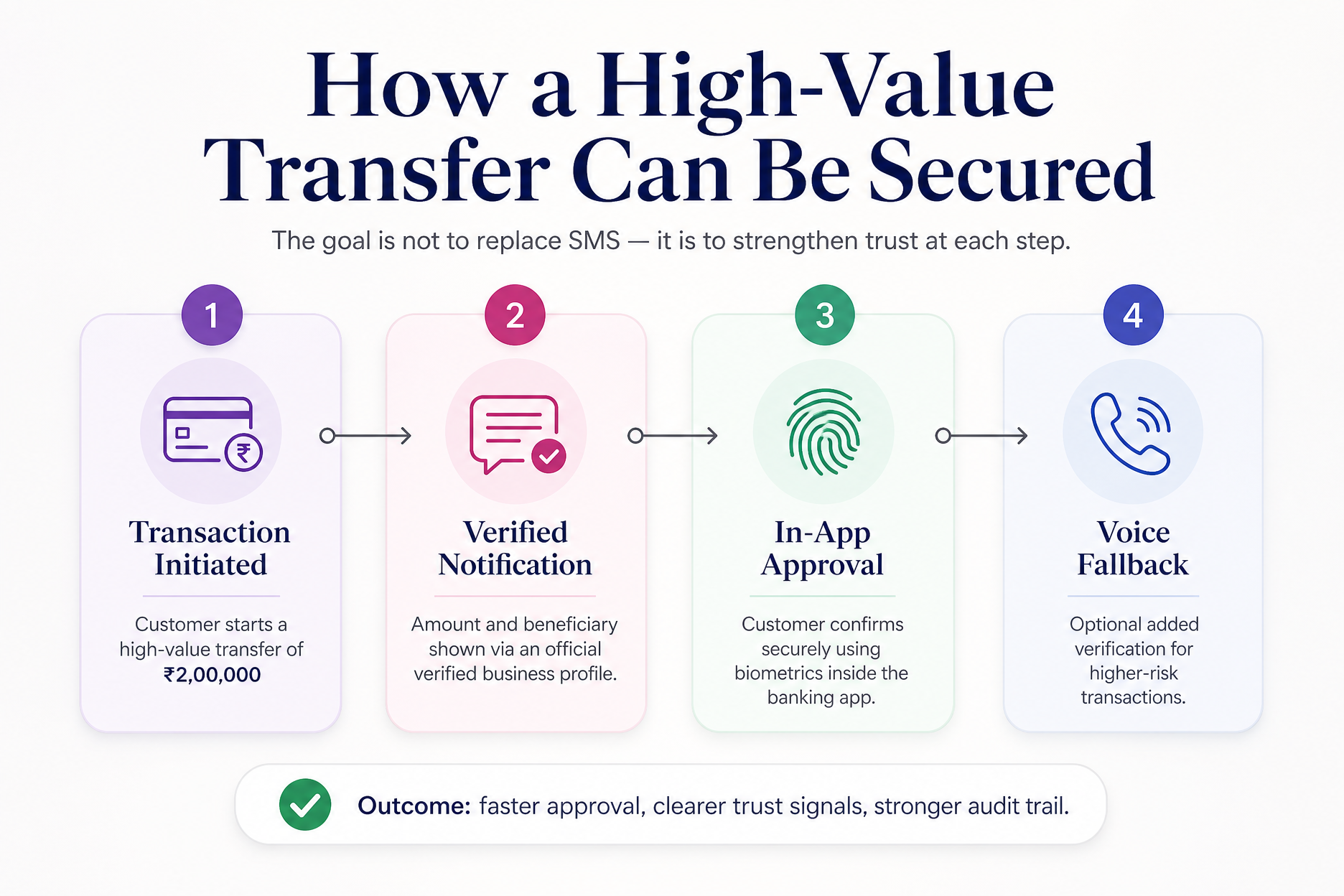
Imagine a customer named Priya initiating a ₹2 lakh transfer.
In the traditional journey, she receives a single SMS containing a six-digit OTP. She enters the code, the transaction is completed, and the interaction ends.
Now imagine the same transaction through a layered communication journey.
Priya first receives a verified WhatsApp notification displaying the transaction amount, beneficiary details and her bank’s verified business profile.
She approves the transaction within her banking application.
If additional verification is required, she receives an automated voice confirmation before the payment is processed.
The transaction still takes less than a minute.
The difference is confidence.
She knows the communication is genuine.
She understands exactly what she’s approving.
And the bank has a stronger audit trail supporting every interaction.
Security has improved.
So has customer trust.
The Opportunity Most Banks Overlook
When people think about customer communication, they often think about marketing.
But every transactional message is also a branding opportunity.
- Every verified sender name.
- Every authenticated notification.
- Every proactive fraud alert.
- Every payment confirmation.
These aren’t promotional messages. They’re trust-building moments.
Customers may forget the advertisement they saw last week.
They rarely forget the institution that made banking feel safe and effortless.
That’s why communication is becoming one of the most important competitive advantages in financial services.
Not because it sells more. Because it reassures more.
Where Seven Oceans Teleservices Fits In
At Seven Oceans, we believe customer communication shouldn’t rely on a single channel. We help banks, NBFCs, insurance companies and fintech businesses build secure, reliable customer journeys across SMS, Verified WhatsApp, RCS, Voice and Email—ensuring every important message reaches customers through the right channel, at the right time.
Whether it’s transaction alerts, OTP delivery, fraud notifications, account updates, loan servicing or customer engagement, our focus is simple: helping financial institutions communicate with greater security, consistency and confidence.
Because in banking, trust isn’t built only through transactions.
It’s built through every message that follows them.
One Question to Think About
If one of your customers initiated a high-value transaction today, would they immediately know that every message they receive is genuinely from your bank?
Or would they have to stop and wonder?
In today’s digital world, that moment of uncertainty may be the biggest risk of all.
If you’re ready to build a more trusted customer communication strategy, let’s start the conversation.
- Reading Time: 6 Minutes
- Snapshot: Banking fraud is evolving faster than traditional authentication methods. Discover why leading financial institutions are strengthening customer communication beyond SMS OTPs – and what it means for customer trust, compliance and digital banking.
- Category: Industry Insights
Products
Solution
- Banking & Finance
- Retail & Ecommerce
- Education
- Logistics
- Healthcare
- Entertainment
- Travel & Transport