
With Seven Oceans Teleservices we can make your marketing spend profitable by building relationships, not just transactions. With us, you can focus on tangible outcomes that can foster the growth of your business.
CONTACTS
GFF 2026: The Fintech Conversation Has Moved
from Possibility to Proof
15-September-2026
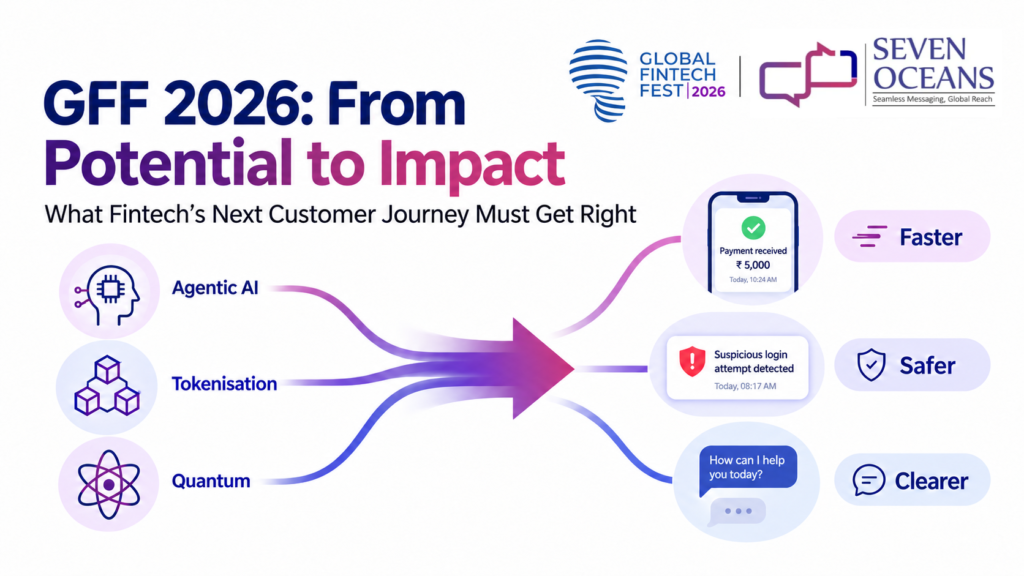
The future of fintech did not arrive at GFF 2026 as one dramatic announcement.
It appeared in several practical shifts.
A payment completed by tapping a phone. Corporate bonds moving through a tokenised settlement pilot. A voice assistant helping customers bank through conversation. An AI agent that does not merely answer a question but takes the next authorised action.
The official theme was “Potential to Impact: Agentic AI | Tokenisation | Quantum.” By the end of the event, the important word was not potential.
It was impact.
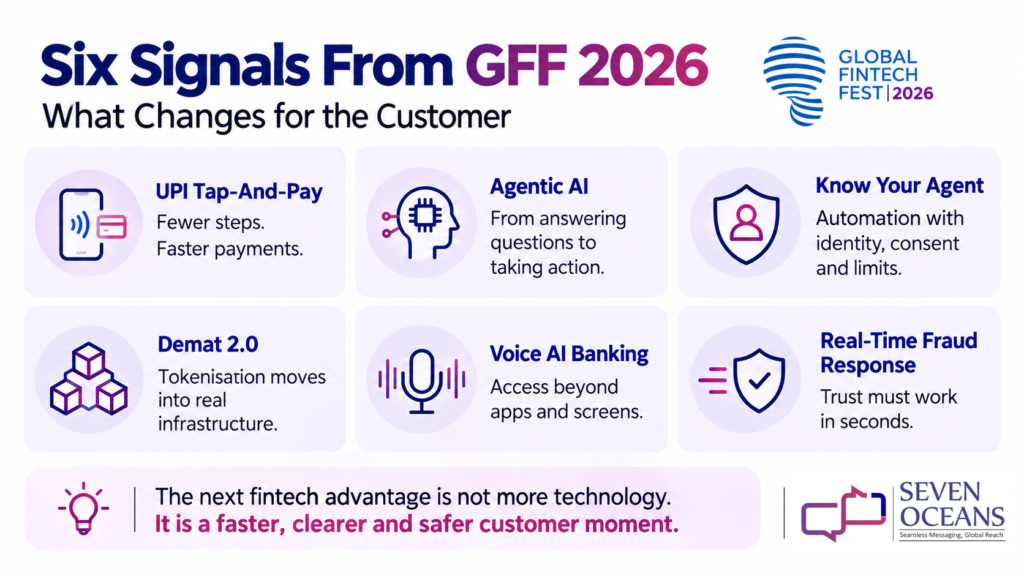
Across the sessions, launches and conversations, the strongest ideas were the ones that made technology easier to use, safer to trust or more accessible to people. Here are six takeaways that stayed with us.
1. Convenience Is Now Measured in Steps Removed
One of the most relatable announcements was NPCI’s new UPI tap-and-pay capability. It allows a customer to complete a payment by tapping a smartphone at a compatible point-of-sale terminal, without first opening a UPI application. It is also designed to work where internet connectivity is weak or unavailable.
The technology behind it matters. But the customer experiences something much simpler: fewer steps at the counter.
That is an important lesson for every fintech product. Customers rarely ask how advanced the architecture is. They notice how quickly they can complete the task.
The next customer-experience breakthrough may not require another screen or feature. It may come from removing one unnecessary action from a moment that already exists.
2. AI Has Moved from Answering Questions to Taking Action
Agentic AI was everywhere at GFF 2026, but one launch made the shift particularly clear. BharatPe introduced an AI assistant for merchants that can take actions across more than 60 connected systems—not merely answer queries.
That changes the role of AI.
A chatbot may explain how to download a statement. An agentic system may identify the account, retrieve the statement, send it through the approved channel and record that the request was completed.
For customers, this could mean shorter journeys. For businesses, it could reduce the manual coordination required across support, operations and back-office teams.
But action introduces risk. An AI that can do more also needs clearer limits, permissions and accountability.
3. “Know Your Agent” May Become as Important as “Know Your Customer”
SBI Chairman C. S. Setty introduced one of the event’s most thought-provoking ideas: banks may need a “Know Your Agent” framework as AI agents begin participating directly in financial processes.
The questions are practical. Which agent is acting? What authority has it been given? Did the customer consent? What transaction limits apply? Can every action be audited or revoked?
This made the AI conversation feel more mature. The industry was no longer asking only whether AI can perform a task. It was asking how that task can remain traceable, bounded and accountable.
The principle applies beyond banking. If an automated system can initiate a reminder, update a record, recommend a product or trigger a transaction, businesses need to know exactly what it is permitted to do – and when a person must step in.
4. Tokenisation Finally Looked Less Like a Presentation Slide
SEBI and RBI used GFF 2026 to launch Demat 2.0, a pilot involving tokenised corporate bonds, wholesale CBDC and smart contracts. The pilot is intended to bring the security and settlement sides of a transaction closer, support faster settlement and automate parts of asset servicing.
The launch began with real corporate-bond issuances. That detail mattered because it moved tokenisation from a future possibility to a working test within India’s existing financial ecosystem.
Nandan Nilekani’s “Finternet” vision stretched the idea further. He spoke about tokenising assets such as farm produce, warehouse receipts, invoices and even livestock – making information about identity, ownership and value more portable across systems.
The larger takeaway was not simply that more assets can become digital. It was that interoperability can unlock access. A small business or farmer should be able to carry trusted information to more than one institution instead of rebuilding credibility each time.
5. Voice Is Becoming a Serious Inclusion Layer
Indian Bank launched AI-TARA, a voice-based conversational banking assistant, alongside new personal-finance and corporate cash-management tools. The announcement reflected another theme heard across the event: speaking can sometimes make digital finance more accessible than typing.
This matters in a country with many languages, varying levels of digital comfort and millions of customers who may find a conversation more natural than navigating menus.
Voice AI can help customers check information, understand a process, receive a reminder or complete a basic request. But inclusion depends on more than translating a script. The system must recognise intent, handle accents, confirm important details and transfer the conversation when it is uncertain.
The most inclusive interface may not always be a new application. Sometimes, it is simply a familiar voice that helps the customer take the next step.
6. In Instant Finance, Trust Must Also Move in Real Time
The conversations about fraud were among the most urgent at GFF 2026. Industry leaders discussed how money can move through mule accounts so quickly that the traditional fraud-response window may no longer be enough. In some cases, detection and intervention may need to happen within 30 seconds to one minute.
This turns customer communication into part of the security infrastructure.
A risk engine may identify an unusual transaction instantly. But if the customer receives an unclear alert several minutes later or has no simple way to respond, the system has only completed half the job.
Verified sender identities, immediate alerts, clear language and simple actions such as Confirm, Block or Speak to Support can help turn detection into intervention.
RBI Governor Sanjay Malhotra also urged fintech companies to treat customer data as a fiduciary responsibility rather than merely a business asset. That message connected privacy, consent, cybersecurity and customer trust into one expectation: growth cannot come at the cost of confidence.
What the Exhibition Floor Made Clear
GFF brought together banks, fintech companies, infrastructure providers, AI platforms and communication businesses. Different companies were solving different parts of the journey, but the conversations repeatedly met at the same place – the customer’s phone.
The phone is now a payment instrument, bank branch, service desk, identity checkpoint and fraud-warning system. That means the message, call or notification appearing on it is no longer a small operational detail.
It is part of the financial product.
For Seven Oceans Teleservices, this was the most relevant learning. SMS, WhatsApp, RCS, Email and Voice AI are often discussed as delivery channels. In fintech, they increasingly form the layer through which customers understand and act on what the underlying system is doing.
A successful payment needs a clear confirmation. A suspicious transaction needs an immediate response path. An onboarding journey needs timely guidance. An AI-driven decision needs an understandable explanation and access to a person when required.
Communication is not what happens after the technology works.
It is part of how the technology works for the customer.
From Potential to Impact
GFF 2026 showed that India’s fintech ecosystem is not waiting for Agentic AI, tokenisation and advanced payment experiences to become distant realities. Pilots are running. Products are launching. Governance questions are becoming more specific.
The next test is whether these capabilities can work reliably at scale without losing transparency, accessibility or trust.
Customers may never see the architecture behind a tokenised settlement, an AI agent or a real-time risk engine. They will experience a faster payment, a clearer alert, an easier conversation or a safer decision.
That is the point where impressive technology becomes useful technology.
And that is where potential becomes impact.
Reading Time: 5 Minutes
Snapshot: GFF 2026 was not only about what emerging technology might achieve. New payment experiences, tokenised settlements, action-taking AI and voice banking showed how fintech is moving from possibility to practical impact.
Category: Fintech / Industry Insights
Products
Solution
- Banking & Finance
- Retail & Ecommerce
- Education
- Logistics
- Healthcare
- Entertainment
- Travel & Transport