With Seven Oceans Teleservices we can make your marketing spend profitable by building relationships, not just transactions. With us, you can focus on tangible outcomes that can foster the growth of your business.
CONTACTS
Your Festive Offer Went Out.
Why Are Customers Still Not Buying?
13-OCTOBER-2026
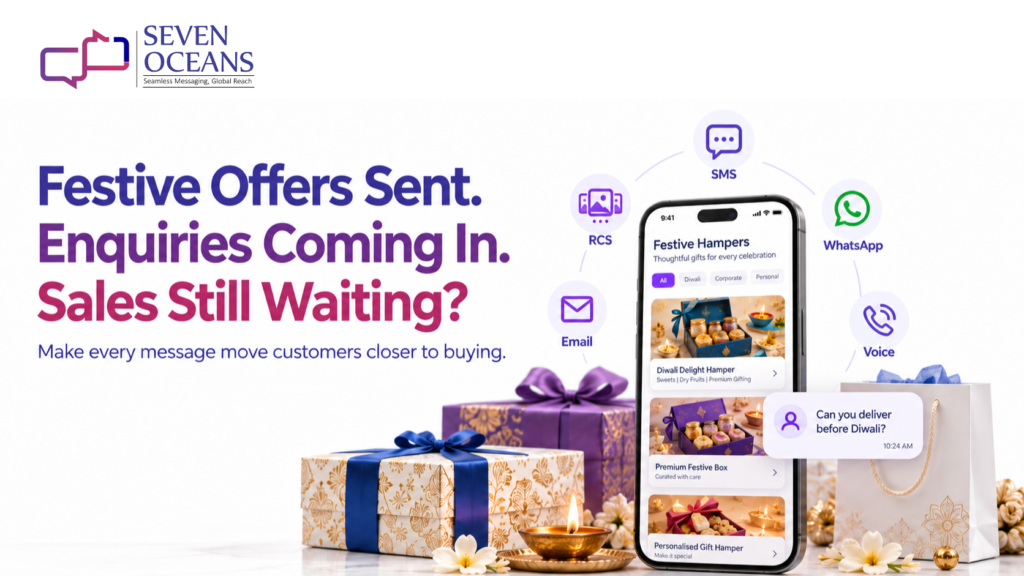
The offer is approved. The creative is ready. The customer list is uploaded.
“Let’s send it to everyone before the festive rush.”
Somewhere, several other marketing teams are having the same conversation.
Your customer’s phone lights up with discounts, early access offers and “last chance” reminders. Your carefully planned campaign becomes one more notification between a courier update and the family WhatsApp group.
The report shows messages delivered. The sales team asks where the enquiries are.
So the next instruction comes: “Send another reminder.”
This is where festive marketing can become expensive. Every weak response leads to another send, without anyone asking whether the customer needed that message in the first place.
Reach still matters. So do the offer, delivery and buying experience. But when you already have a reachable audience, increasing volume alone may do little to improve results.
A better festive marketing campaign strategy starts with deciding who needs to hear from you, when they need it and what should happen next.
Your customer does not see your campaign calendar
Inside the marketing team, Monday’s Email, Wednesday’s WhatsApp message and Friday’s SMS are separate activities.
For the customer, they are three messages from the same brand.
Add competing offers, festive shopping, work deadlines and travel plans, and attention becomes harder to earn.
Sending more can increase the number of opportunities to be seen. It can also repeat an irrelevant offer, interrupt someone who has already purchased or generate enquiries your team cannot handle quickly enough.
Before adding another send, ask:
What will this message help the customer decide or do?
If the answer is simply “remember our sale,” the campaign may need a stronger reason to contact them.
1. Choose timing around the purchase, not just the festival
There is no single magic hour that makes every festive campaign work.
An office gifting buyer may need time for approvals, quantities and delivery arrangements. Someone buying an outfit may need time to choose a size, receive the order and arrange an exchange.
A message sent on the festival morning could arrive after both decisions are over.
Work backwards from the customer’s buying deadline. Consider delivery cut-offs, store hours, approval cycles and when your team can respond.
Then use your own campaign history to test suitable send windows. Look at when customers click, enquire and purchase. Test different times with comparable audience groups, and use the results to guide your next campaign.
Staggering sends can also help your team manage replies. If everyone receives the campaign together, everyone who needs help may arrive together too.
A well-timed message leaves enough time to act on it.
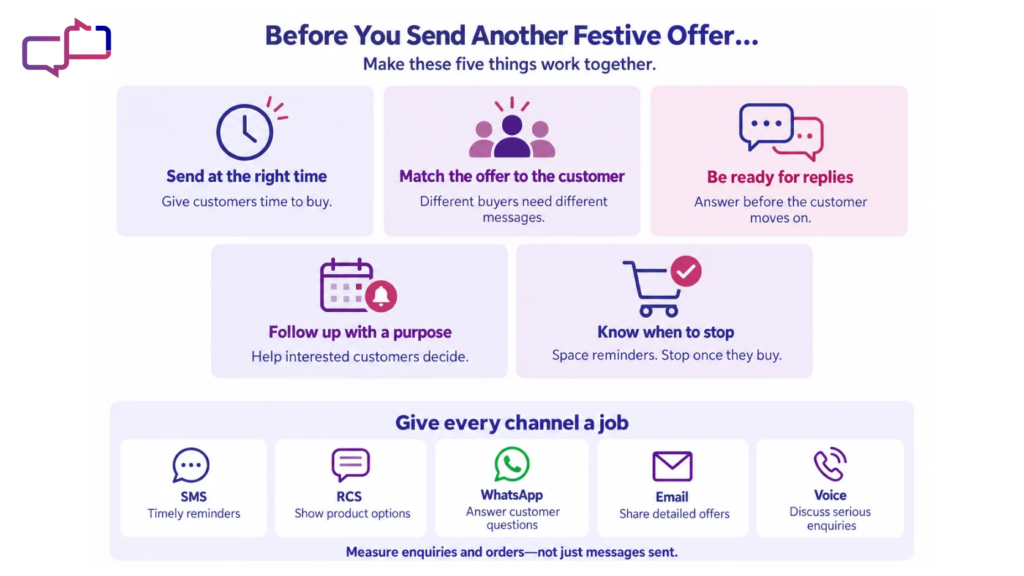
2. Give different customers different reasons to respond
A festive discount may mean very little to a customer who bought the same product yesterday.
A corporate buyer asking about 200 gift boxes needs information that a first-time shopper does not.
Segmentation starts by recognising those differences. Group customers by what they have purchased, what they have asked about and how recently they have shown interest. Then give each group a relevant reason to respond.
For a festive campaign, useful groups could include:
- Recent buyers: Share relevant add-ons or gifting ideas, while excluding them from reminders for the product they just purchased.
- Customers with active enquiries: Answer the question holding up their decision, such as delivery, availability or bulk pricing.
- Repeat customers: Offer relevant recommendations based on earlier purchases.
- Customers who showed recent interest: Follow up on the category or offer they explored, where that activity is available and appropriate to use.
- Customers who have been inactive: Start with a useful reason to reconnect before increasing promotional frequency.
You do not need dozens of complicated segments. Even a few clear groups can make the message more useful.
Keep each send within the audience’s communication permissions and preferences.
3. Set frequency limits across the whole campaign
“Only one message from our team” can still become several messages from your business.
The Email team sends an announcement. The WhatsApp team sends a reminder. A sales executive follows up. An automated journey sends another nudge.
Nobody thinks they are overdoing it. The customer experiences all of it.
Set a shared limit for promotional contact across channels. Decide how much space to leave between messages and when a customer should stop receiving a sequence.
There is no universal number that suits every audience. Use previous results, customer preferences and the length of the buying journey to set your starting point.
Then watch for signs that more contact is becoming less useful: falling responses, opt-outs, complaints or repeated sends with little additional revenue.
Keep essential service updates, such as order confirmations, separate from promotional planning.
Buying should change the next message a customer receives. Someone who has completed an order should move out of that offer’s purchase reminders.
4. Build a sequence that changes with customer behaviour
A campaign sequence should move the decision forward.
Imagine a retailer promoting festive gifts:
| Stage | Purpose | Who receives it |
|---|---|---|
| Introduce the collection | Help customers discover relevant gift options | Suitable customers who have opted in |
| Follow up on interest | Share useful product or delivery information | Customers who engaged but have not purchased |
| Remove a barrier | Help resolve a question about size, stock or delivery | Customers with an active enquiry |
| Send a final reminder | Highlight a genuine offer expiry or order cut-off | Interested customers who still have time to buy |
| Support the purchase | Confirm the order and explain the next steps | Customers who purchased |
The exact dates depend on the business. The important part is that each stage has a purpose and customers leave the sequence when it no longer applies.
Give channels a clear role too. Email can explain a collection in detail. WhatsApp can support questions and conversations. RCS can present product options with visual elements. SMS can carry a concise, timely reminder.
You do not need to send the same offer through every channel. Choose the next contact based on what the customer needs and how they prefer to hear from you.
5. Prioritise customers who are already close to buying
When budgets and response capacity are limited, pay attention to the people showing a current need.
Someone asking, “Can you deliver 50 gift boxes by Friday?” deserves a quick answer.
Useful signs of intent can include an active quotation, a recent product enquiry, an unfinished checkout or repeated interest in a relevant offer. A single open or click is a weaker signal and should not be treated as a purchase commitment.
Build follow-ups around the decision still outstanding:
“Do you need help confirming the delivery date?”
“Would you like the available size options?”
That may help more than another generic discount reminder.
Make sure someone owns the reply. A campaign that generates interest still needs a team ready to turn that interest into an order.
Measure what the next send actually adds
Messages delivered are useful to track. They do not tell the whole story.
Look at qualified enquiries, completed purchases, revenue after messaging costs and discounts, response times and opt-outs.
Compare those results by segment and campaign stage. Where practical, keep a small comparable group out of an additional reminder to help assess whether that reminder produced extra purchases.
Sometimes an extra send earns its place. Sometimes it adds cost while reaching customers who would have bought anyway.
The goal is to understand the difference.
Before you increase the volume, improve the reason to send
Festive campaigns can become a race to press “send” before another brand does.
But the customer is trying to finish their shopping, choose a gift or get an order delivered on time.
A useful festive marketing campaign strategy follows that decision: reach the right group early enough, give them relevant information, leave sensible space between messages and respond when they show interest.
At Seven Oceans Teleservices, we help businesses plan and manage customer communication across SMS, WhatsApp Business API, RCS, Voice and Email.
Before your next festive send, ask one question:
Will this message help the customer take the next step or just give them another notification to clear?
- Reading Time: 5 Minutes
- Snapshot: Your festive offers are going out, but enquiries and sales are falling short. What you’ll learn:
- Send offers while customers still have time to buy.
- Match messages to different customer needs.
- Handle enquiries before customers move on.
- Follow up without overwhelming customers.
- Use SMS, RCS, WhatsApp, Email and Voice at the right step.
- Category: Festive Advertising / Marketing Strategy
Products
Solution
- Banking & Finance
- Retail & Ecommerce
- Education
- Logistics
- Healthcare
- Entertainment
- Travel & Transport