
With Seven Oceans Teleservices we can make your marketing spend profitable by building relationships, not just transactions. With us, you can focus on tangible outcomes that can foster the growth of your business.
CONTACTS
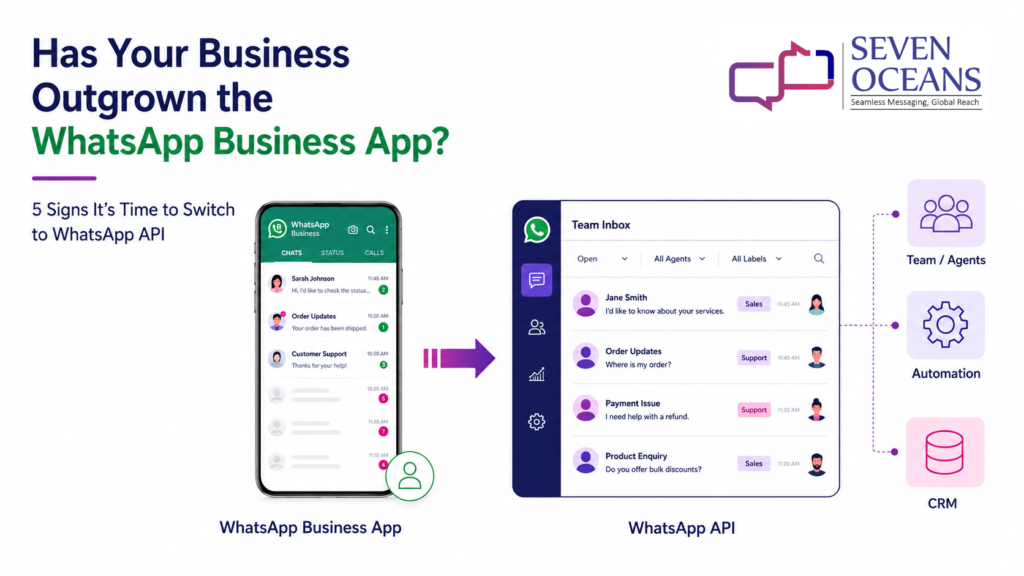
Has Your Business Outgrown
the WhatsApp Business App?
02-September-2026
Your business sends a festive offer on WhatsApp.
Then a weekend discount.
Then a “Last Day to Buy” reminder.
But what happens when a customer replies?
Who handles the enquiry? How quickly do they respond? And what happens after the customer makes a purchase?
Many businesses use WhatsApp for promotions. But its real value begins when it supports the entire customer journey, from the first enquiry to the next purchase.
The question is: can the WhatsApp Business App manage that journey as your business grows?
A Promotion Is One Message. A Journey Is a Connected Experience.
Imagine a customer sees your advertisement and starts a WhatsApp conversation.
A chatbot understands their requirement, shares relevant information and collects basic details. The conversation is then assigned to the right salesperson.
After the purchase, the customer receives a payment confirmation, order updates and delivery notifications. A feedback message follows. Later, they receive a relevant reminder based on their previous purchase.
One customer. One familiar channel. One connected journey.
WhatsApp can support lead capture, product discovery, enquiry handling, payment reminders, order updates, customer support, feedback and repeat purchases.
That is very different from sending the same promotional message to hundreds of contacts and waiting for responses.
But Can the Business App Keep Up?
The WhatsApp Business App works well when a small team is personally managing a comfortable number of conversations.
The problem begins when WhatsApp stops being one person’s inbox and becomes an important sales, marketing and customer-service channel.
There is no fixed number of messages that tells you when to switch. The clearest sign is that your team can no longer manage every conversation reliably.
Here are five warning signs.
1. Everyone Has Access, but Nobody Has Ownership
Linked devices allow several employees to access the same WhatsApp number. But shared access does not create a shared workflow.
Two employees may reply to one customer, while another enquiry remains unanswered. Messages may be opened without any follow-up because everyone assumes someone else is handling them.
With WhatsApp API, the number can connect to a shared team inbox where conversations are assigned, routed and monitored.
2. Enquiries Are Getting Missed
As message volumes increase, an important sales enquiry can easily disappear beneath routine questions, campaign responses and support requests.
The customer may still be interested. But by the time someone notices the message, they may have contacted another business.
An API-based setup can categorise enquiries, route them to the right team and flag conversations that remain unanswered.
3. Delayed Replies Are Becoming Normal
Customers do not always message during office hours. They contact a business when they see an advertisement, remember a requirement or are ready to make a decision.
If every response depends on an employee being available, delays are unavoidable.
Automation can acknowledge the enquiry immediately, answer common questions and collect basic information. When a salesperson joins, the conversation has already moved forward.
The chatbot does not replace the team. It prevents the customer from feeling ignored.
4. Broadcast Lists Are Becoming Difficult to Manage
Broadcast lists may work when the customer base is small. But as the database grows, manually maintaining different lists becomes time-consuming.
Customers may receive irrelevant offers. Contacts may be placed in the wrong group. The marketing team may also struggle to understand which campaign produced actual enquiries or sales.
WhatsApp API allows businesses to communicate with opted-in customers using approved templates, better segmentation and structured campaign reporting.
Marketing becomes more relevant and less dependent on manually maintained lists.
5. Your Team Is Copying Information Between Systems
A lead arrives on WhatsApp. Someone enters it into a spreadsheet. Another employee adds it to the CRM. Payment details are checked separately, and follow-ups depend on manual reminders.
Every extra step creates another opportunity for delay or error.
WhatsApp API can connect with CRM, billing, support and other business systems. Customer details can be captured automatically. Conversations can be routed according to predefined rules. Payment reminders can stop once payment is received, and order updates can be triggered when the status changes.
This is often the clearest sign that the Business App is no longer enough.
So, When Should You Switch?
Continue with the WhatsApp Business App when conversation volumes are manageable and manual follow-ups remain reliable.
Consider moving to WhatsApp API when:
- Multiple employees need clear conversation ownership
- Enquiries are regularly missed or answered late
- Broadcast lists are difficult to organise
- Routine questions are taking up the team’s time
- WhatsApp needs to connect with a CRM or another system
- Management needs better visibility into team performance
If several of these problems already sound familiar, your business may not simply need more people handling WhatsApp.
It may need a better WhatsApp system.
The API Is Not Only for Large Enterprises
A clinic with three employees may need automation because it receives enquiries throughout the day. A retailer may need CRM integration to manage orders and repeat purchases. A real estate company may need leads routed according to budget and location.
Business size is not the deciding factor.
The right time to switch is when missed conversations, delayed responses and manual work begin affecting sales or customer experience.
At Seven Oceans Teleservices, we help businesses move beyond promotion-only messaging by building WhatsApp journeys for lead capture, automation, team routing, CRM integration, customer updates, support and repeat engagement.
Because growing on WhatsApp is not about sending more messages.
It is about managing every customer conversation better.
Reading Time: 4 Minutes
Snapshot: Many businesses start with the WhatsApp Business App for promotions and customer enquiries. But as conversations grow, missed messages, delayed replies, unclear ownership and manual follow-ups become common. This article explains the warning signs that indicate it may be time to move to WhatsApp API and build a more connected customer journey.
Category: WhatsApp Business & Automation
Products
Solution
- Banking & Finance
- Retail & Ecommerce
- Education
- Logistics
- Healthcare
- Entertainment
- Travel & Transport