
With Seven Oceans Teleservices we can make your marketing spend profitable by building relationships, not just transactions. With us, you can focus on tangible outcomes that can foster the growth of your business.
CONTACTS
Your Business Does Not Have a Lead Problem.
It Has a Follow-Up Problem.
25-AUGUST-2026
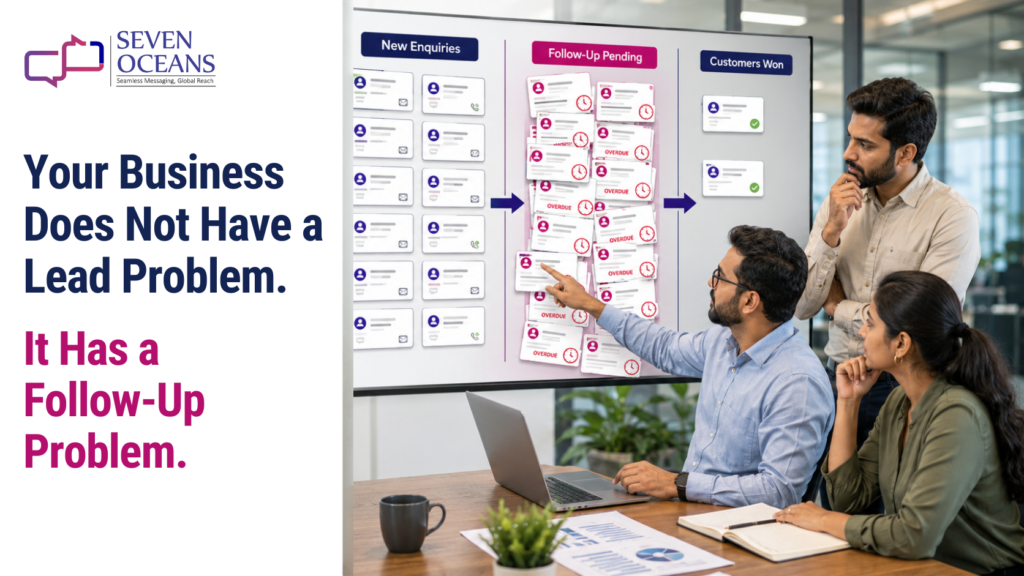
Most businesses assume that slow sales mean they need more leads. So they spend more on advertisements, launch another campaign and try to bring more people into the funnel.
But before generating more enquiries, there is a simpler question to ask: What happened to the leads you already received?
A customer filled out a form. Someone messaged your business on WhatsApp. A prospect called while your team was busy. The interest was real, but the response came hours later, or never came at all. By then, the customer had moved on.
That is not always a lead-generation problem. It is often a follow-up problem.
A lead is only the beginning
A new enquiry is a moment when the customer is actively thinking about your product, service or solution. What happens next determines whether that interest becomes a conversation or quietly disappears.
Yet follow-up is often treated like an administrative task. The enquiry enters a spreadsheet, gets forwarded and waits until someone is free. Customers do not see the internal reason for the delay; they only know that nobody responded.
Website forms checked too late, WhatsApp enquiries buried in a busy inbox, missed calls without callbacks and forgotten quotations are all signs of a broken process. Sending more leads into it simply creates more opportunities to lose them.
Why manual follow-up breaks as a business grows?
Manual follow-up can work when enquiries are few. As the business grows, leads begin arriving from social media, advertisements, the website, events, referrals and missed calls. Information gets scattered, ownership becomes unclear and prospects are missed or contacted twice.
This is a system problem. The answer is not to ask employees to remember more; it is to create a process that remembers for them.
What a better follow-up journey looks like?
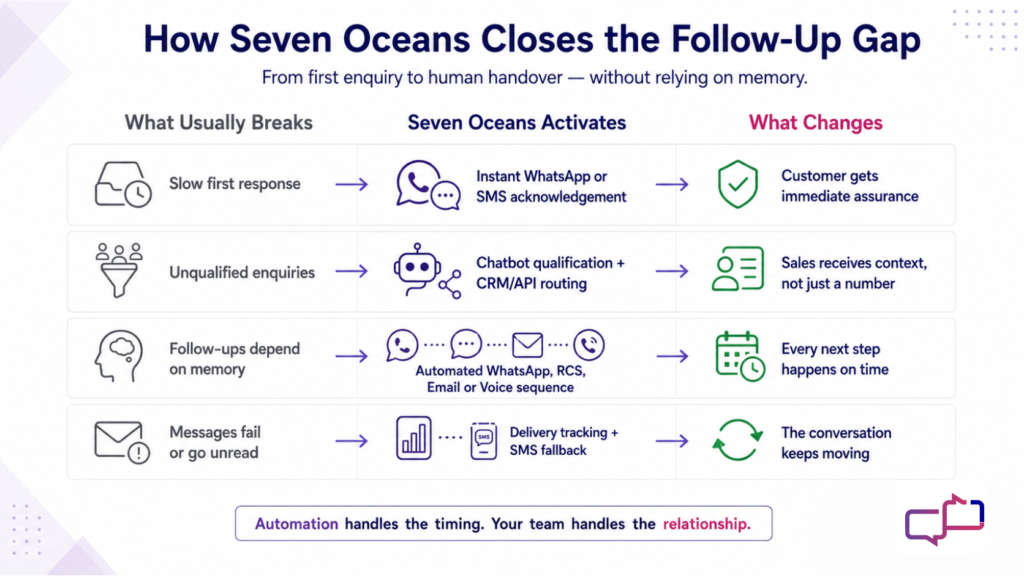
A useful journey can acknowledge the enquiry immediately, ask one or two relevant questions and assign it to the right person with the information already collected. If the conversation stops midway, a timely reminder can be triggered.
When advice, negotiation or personal attention is required, a human should take over with the full context. Good automation supports the conversation; it does not take it over.
Every channel has a different job
Better follow-up does not mean sending the same message through every channel. It means using the channel that fits the moment.
WhatsApp works well when the customer needs a conversation, wants to share information or requires assistance before deciding. SMS is useful for short, urgent and widely accessible communication such as alerts, confirmations and reminders.
RCS can make communication more visual and interactive through verified branding, rich media and clear action buttons. Voice and Voice AI can support reminders, confirmations, lead qualification and multilingual interactions, especially when speaking is easier than typing. Email remains valuable for proposals, statements, documents and detailed information that customers may want to review later.
The question is not, “Which is the best channel?” The better question is, “What does the customer need at this stage?”
The principle works at any scale
For a clinic, an automated journey can acknowledge an enquiry, ask which service is required, collect a preferred appointment time and pass the details to the receptionist.
For a retail brand, it can identify the customer’s location and interest, route the enquiry to the right team, update the CRM and schedule the next relevant message.
The scale is different. The principle is the same: respond quickly, understand the requirement and make the next step easy.
Automation should still feel human
Follow-up is not the same as chasing. Good follow-up is timely, relevant and permission-based. When a message does not help the customer make progress, sending more only creates more noise.
The goal is not to contact every lead repeatedly. It is to make every interaction useful.
Measure what happens after delivery
Message delivery alone does not tell you whether follow-up is working. Track the first-response time, leads contacted and qualified, points where customers drop off and conversations that become appointments, orders or paying customers.
Monitor opt-outs too. They can reveal when communication is too frequent, poorly timed or irrelevant.
Start with one broken moment
You do not need to automate everything at once. Start with one point where leads are regularly lost: a missed call, a website form that receives a late response, a busy WhatsApp inbox or a quotation that is never followed up.
Map what happens today. Decide what the customer should receive next, define who should take ownership and automate the first useful step. Then measure whether more enquiries are moving forward.
Before generating more leads, fix what happens next
Lead generation will always matter, but generating more enquiries cannot compensate for a weak follow-up process. Businesses should not have to choose between personal communication and scalable communication. Technology can handle speed, routing and reminders while people handle trust, judgement and relationships.
At Seven Oceans Teleservices, we help businesses design and manage customer communication using SMS, WhatsApp Business API, RCS, Voice, chatbots and email. The technology is only one part of the solution. The real value comes from making sure the right conversation happens at the right time.
Before investing in the next campaign, look at the enquiries already entering your business. Your next customer may already be waiting for a reply.
Reading Time: 4 Minutes
Snapshot: Businesses often respond to slow conversions by generating more leads. But the real problem may be what happens after a customer shows interest. A timely and relevant follow-up journey can turn more enquiries into customers.
Category: Customer Communication | Automation
Products
Solution
- Banking & Finance
- Retail & Ecommerce
- Education
- Logistics
- Healthcare
- Entertainment
- Travel & Transport