With Seven Oceans Teleservices we can make your marketing spend profitable by building relationships, not just transactions. With us, you can focus on tangible outcomes that can foster the growth of your business.
CONTACTS
The "Right Message, Wrong Room" Problem:
Rethinking WhatsApp and RCS
21-OCTOBER-2026
Think about how you use your phone on a typical Tuesday afternoon.
You open WhatsApp because you have something to say or someone just pinged you. It is personal, immediate, and informal. A continuous stream of family updates, group banter, and active project chats.
Then you check your default phone messages. You aren’t there to chat. You are there to grab a delivery code, check a flight status, or see if your bank transfer went through. You scan, tap what you need, and put the phone back down.
Both screens sit on the same device, inches apart. Yet mentally, your customer treats them like two completely different rooms in their house.
For years, brands have ignored this distinction. If a message had pictures or buttons, it went to WhatsApp. If it was plain text, it went to SMS.
Now that Rich Communication Services (RCS) puts rich cards, branding, and carousels directly inside the default inbox, that old logic falls apart. Choosing between WhatsApp and RCS isn’t a technical decision. It is an etiquette decision.
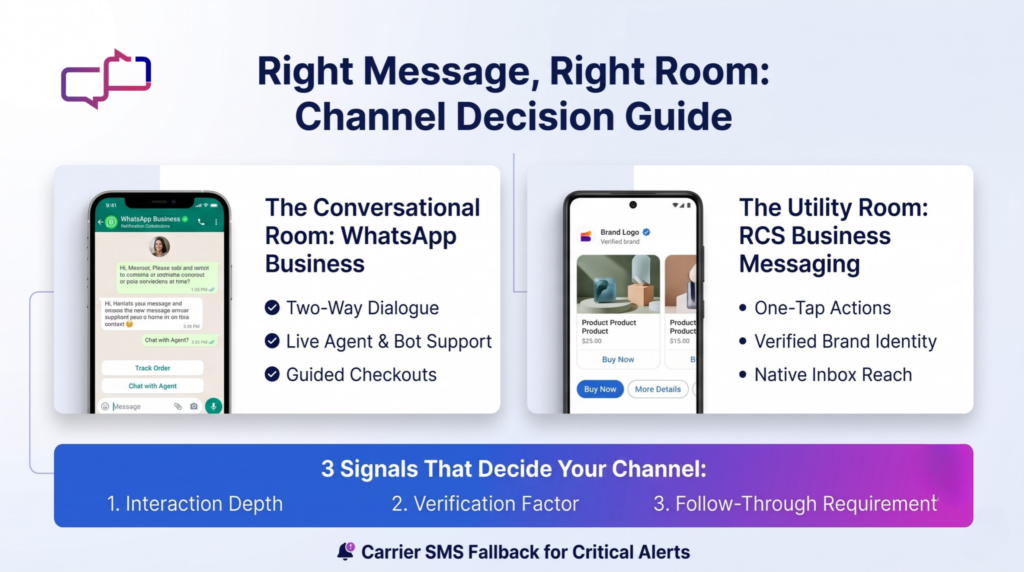
The Conversational Room vs. The Utility Room
To pick the right channel, step out of the marketing dashboard and look at the customer’s mental space.
The Conversational Room (WhatsApp)
WhatsApp is an interactive living room. People step inside expecting dialogue.
When a brand enters this room, it needs to behave like a participant in a conversation, not a billboard on a highway:
What works: “Your claim document has been reviewed. Would you like to confirm the payout account now or speak to a representative?”
What feels out of place: An unprompted, one-way image blast with five generic promotional bullet points that expects no reply.
If a customer replies to your message, are you genuinely set up to listen and answer back in seconds? If the answer is no, you are shouting into a room meant for conversation.
The Utility Room (RCS)
The native messaging app is an information desk. People look at it to find answers quickly and move on with their day.
RCS gives this room visual clarity without disturbing the customer’s personal conversation feed:
What works: A verified sender card showing an order preview, dynamic shipment status, and a single button: Track Package. No typing required, no chat thread to archive later.
What feels out of place: Asking open-ended questions like “Tell us how we can help you today!” where users don’t naturally expect a live chat experience.
The Three Signals That Decide the Channel
Instead of picking a single preferred channel for your whole quarterly plan, run each campaign idea through three simple filters:
[ Your Message Concept ]
│
▼
1. Is an immediate two-way dialogue required?
├─ YES ──► WhatsApp (Live agent, guided qualification, bot journey)
└─ NO
│
▼
2. Does the customer need to take a single, immediate action?
├─ YES ──► RCS (Add to calendar, verify appointment, view card)
└─ NO
│
▼
3. Is it a time-critical operational alert?
└──────► Carrier SMS / Fallback (Zero dependency on mobile data)
1. The Interaction Depth
Ask what the ideal next 30 seconds look like for the recipient.
If the next step is interactive negotiation—such as picking a preferred service time from a list, uploading an invoice photo, or asking product specification questions—WhatsApp is the natural home.
If the next step is a one-tap reaction—such as saving a boarding pass, tapping to view a seasonal lookbook, or confirming an address—RCS delivers that visually in the native inbox without opening a third-party app.
2. The Verification Factor
Trust is visual. A generic link from a random 10-digit number in standard SMS triggers instant skepticism.
RCS brings verified brand identity directly into the carrier inbox—verified logo, brand name, and clean layout. For brand discovery and visual updates, this builds instant legitimacy before the customer even taps an external link.
3. The Follow-Through Requirement
What happens when the customer taps an option?
WhatsApp keeps them inside the conversation thread. That is invaluable if you have a team of sales executives or support agents waiting to handle the reply. But if your internal team cannot answer within minutes, an interactive chat message quickly creates frustration.
RCS uses action chips that can trigger native phone features: opening a map location, launching a dialer, saving an event, or navigating directly to a secure web portal. It facilitates the action without creating an expectation of live chat support.
Mapping Real Scenarios
Here is how this approach looks across routine customer touchpoints:
| Customer Touchpoint | Customer Expectation | Best Natural Channel | Why It Works |
| New Collection Drop | Wants to browse visuals quickly without starting an unwanted chat thread. | RCS | Delivers an interactive carousel directly to the native inbox; users can swipe and tap through to the website seamlessly. |
| Post-Purchase Support | Needs to resolve an issue with an item, ask about exchanges, or upload photos. | Built for continuous, context-rich dialogue and agent escalation. | |
| Service Appointment Reminder | Needs quick confirmation or an easy way to save the time to their schedule. | RCS | A verified card with an Add to Calendar or Reschedule action button requires no typing. |
| Inbound Product Inquiry | Customer clicked an ad wanting to know about customization and pricing. | High-intent interaction that benefits from real-time qualification and conversational closing. | |
| Critical Transaction Alert | Needs instant reassurance, regardless of internet connectivity. | SMS Fallback | Instant carrier delivery that bypasses data dependencies entirely. |
Stop Choosing Sides. Start Matching Intent.
The debate between RCS and WhatsApp only exists when companies look at customer communication through internal silos.
Your customer does not think in CPaaS terminology or channel categories. They simply notice whether an interaction felt convenient or annoying, relevant or intrusive.
When you use WhatsApp for genuine conversations and RCS for verified, frictionless utility, you stop cluttering your customers’ personal inboxes with one-way noise and your messages finally earn the attention they deserve.
At Seven Oceans Teleservices, we help businesses plan and manage customer communication across SMS, WhatsApp Business API, RCS, Voice and Email.
Before you schedule your next send, ask one question:
Are you inviting your customer to have a real conversation, or are you just giving them something they need to act on and move forward?
- Reading Time: 4 Minutes
- Snapshot: Sending rich media doesn’t automatically mean defaulting to WhatsApp. Learn how to match your customer’s mental space by choosing between the “Conversational Room” (WhatsApp) and the “Utility Room” (RCS).
Understand how customers mentally separate their personal chat app from their native phone inbox.
Use the 3-signal framework (Interaction Depth, Verification Factor, and Follow-Through Requirement) to pick the right channel.
Deploy WhatsApp Business API for genuine, two-way dialogue and live support.
Leverage RCS Business Messaging for verified, one-tap utility actions and visual product drops.
Keep standard SMS fallback active for time-critical, zero-data continuity.
- Category: Messaging Strategy / Customer Communication
Products
Solution
- Banking & Finance
- Retail & Ecommerce
- Education
- Logistics
- Healthcare
- Entertainment
- Travel & Transport