
With Seven Oceans Teleservices we can make your marketing spend profitable by building relationships, not just transactions. With us, you can focus on tangible outcomes that can foster the growth of your business.
CONTACTS
RCS vs WhatsApp vs SMS
Stop Guessing Start Choosing.
06 -june-2026
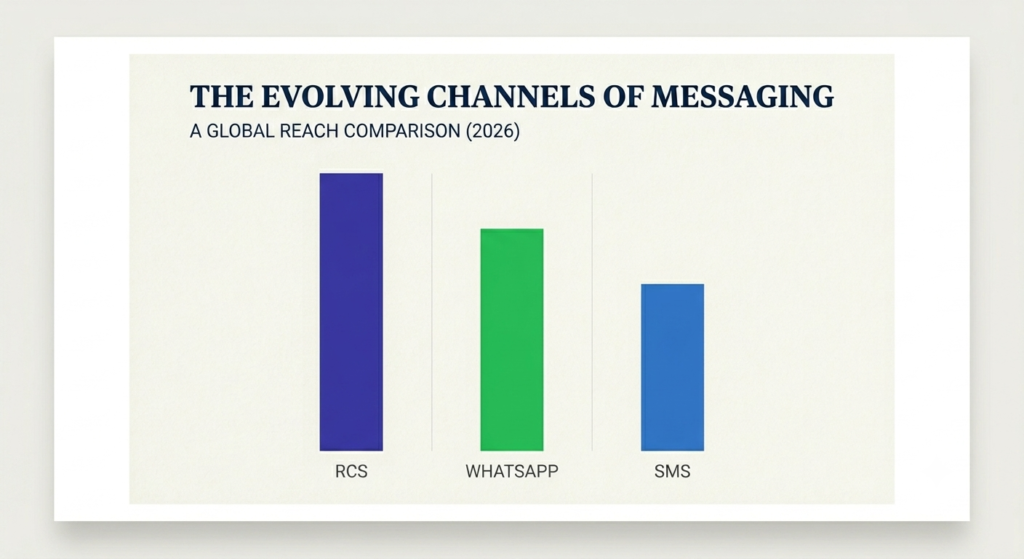
Your customers are on their phones. Always.
The question is no longer whether to reach them on mobile. The question is which channel is actually working — and which one is quietly costing you money.
Most marketing teams are still running the same SMS campaigns they were three years ago. A few have added WhatsApp. Almost none have figured out where RCS fits in.
That uncertainty is expensive.
Why the Old Answer ("Just Use SMS") No Longer Works
SMS was the default for a reason. It works on every phone. No internet required. Delivery is reliable..
But reliable is not the same as effective.
Open rates for SMS hover around 98% — but engagement and conversion are a different story. Plain text messages get read. They rarely get acted on.
Meanwhile, customer expectations have shifted. People want interactions that feel like conversations, not broadcasts.
That gap between what SMS delivers and what customers now expect is where the real opportunity
sits.
What RCS Changes (And Why It Matters Right Now)
RCS — Rich Communication Services — is SMS with a serious upgrade.
Think branded sender profiles. High-resolution images. Product carousels. Tap-to-confirm buttons. All inside the default messaging app. No app download required.
The numbers behind RCS adoption in 2026 are hard to ignore:
- Over 2 billion users are projected to be on RCS-enabled devices globally
- 95% of mobile operators now support RCS
- North America alone is seeing 14x more RCS usage than it did in 2025
- Apple’s integration across iOS has finally made cross-platform rich messaging real
For marketing heads, this is not a future trend. It is a present-tense opportunity.
Brands running RCS campaigns are seeing customers interact within the message — browsing products, confirming orders, tracking deliveries — without ever leaving the chat.
The message becomes the experience. That reduces friction. Reduced friction improves conversion.
Where WhatsApp Fits Into This Picture
WhatsApp is not going anywhere.
With over 3.3 billion monthly active users globally, and India leading with 535 million active users, WhatsApp is where your customers already are.
The difference between WhatsApp and RCS is not about quality. Both support rich media, interactive buttons, and two-way conversations.
The real difference is intent and relationship.
WhatsApp works best when there is an existing customer relationship. Transactional messages. Post-purchase journeys. Support conversations. Loyalty communication. These are contexts where
customers expect and welcome your brand inside WhatsApp.
RCS works best for acquisition-style and broadcast communication. Verified branding builds trust with cold audiences. Interactive elements drive action without requiring customers to be opted into a separate platform.
The brands winning in 2026 are not choosing between the two. They are using both — for different moments in the customer journey.
A Simple Framework for Choosing the Right Channel
Before your next campaign brief, ask these questions:
Use SMS when:
- You need guaranteed delivery regardless of internet access
- Your audience is in a region where RCS or WhatsApp penetration is low
- The message is purely informational and time-sensitive (OTPs, alerts)
Use RCS when:
- You want branded, visual outreach without asking customers to download anything
- You are running awareness or re-engagement campaigns to a broad list
- You want interactive elements — carousels, CTAs, confirmations — in the message itself
Use WhatsApp when:
- You have an existing customer relationship
- The message requires a response or two-way conversation
- You are running post-purchase, support, or retention flows
The mistake most teams make is treating all three as interchangeable. They are not. Each has a context where it outperforms the other two.
The Brands Getting This Right
The clearest signal that a brand has figured out channel strategy is this: their communication feels relevant at every stage.
They are not sending promotional blasts over WhatsApp to people who only signed up for shipping updates. They are not running plain SMS campaigns when RCS would let customers shop directly
from the message.
They are matching the channel to the moment.
That is what separates a messaging strategy from a messaging habit.
What This Means for Your Business
The pressure to get more out of every marketing rupee is real..
Acquisition costs are rising. Attention spans are shrinking. The average customer is overwhelmed by messages from every direction.
Channel strategy is no longer a technical decision delegated to your IT team. It is a growth lever that belongs in the marketing leadership conversation.
Getting it right means fewer wasted sends, higher engagement, and communication that customers actually find useful.
At Seven Oceans Teleservices, we help brands build exactly that — channel-intelligent communication strategies that combine SMS, RCS, and WhatsApp into a single, coherent customer experience. No stack complexity. No guesswork.
If you are rethinking your messaging mix, it might be worth a conversation.
Explore more at sevenomedia.com

And somewhere in the middle of all this noise, a quiet shift is happening. The brands that are
growing — and keeping their customers — are moving their most important conversations to
WhatsApp.
Products
Solution
- Banking & Finance
- Retail & Ecommerce
- Education
- Logistics
- Healthcare
- Entertainment
- Travel & Transport