
With Seven Oceans Teleservices we can make your marketing spend profitable by building relationships, not just transactions. With us, you can focus on tangible outcomes that can foster the growth of your business.
CONTACTS
The Death of Third-Party Cookies:
How B2C Brands Win with Zero-Party WhatsApp Data
05-AUGUST-2026
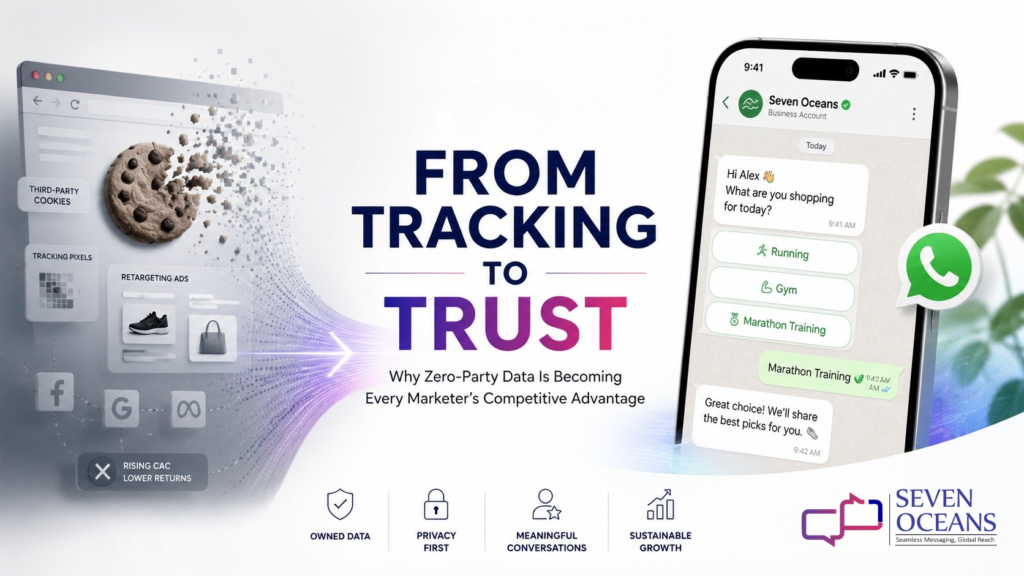
For years, digital marketing worked on a simple premise.
If a customer visited your website, you could follow them across the internet.
A pair of shoes viewed on Monday would reappear in a Facebook ad on Tuesday. A product abandoned in a shopping cart would show up again while they watched videos or read the news.
It wasn’t magic. It was third-party cookies.
That era is rapidly evolving.
Privacy-focused browser updates, stricter data regulations and changing consumer expectations are reshaping how brands collect and use customer data. The marketing playbook that businesses relied on for years is becoming less effective, and acquiring new customers is becoming increasingly expensive.
Which raises an important question: If brands can no longer only rely on tracking people, how will they truly understand them?
The answer isn’t more technology. It’s better conversations.
From Tracking Customers to Understanding Them
For years, marketers depended heavily on data collected by advertising platforms. Customers often had little idea how much of their online behaviour was being tracked, analysed and used for advertising.
Today, that approach is changing.
Consumers expect greater transparency. Regulations demand stronger privacy protections. Browsers are reducing third-party tracking by default.
As a result, businesses are shifting towards owned customer data –information collected directly from customers with their knowledge and consent.
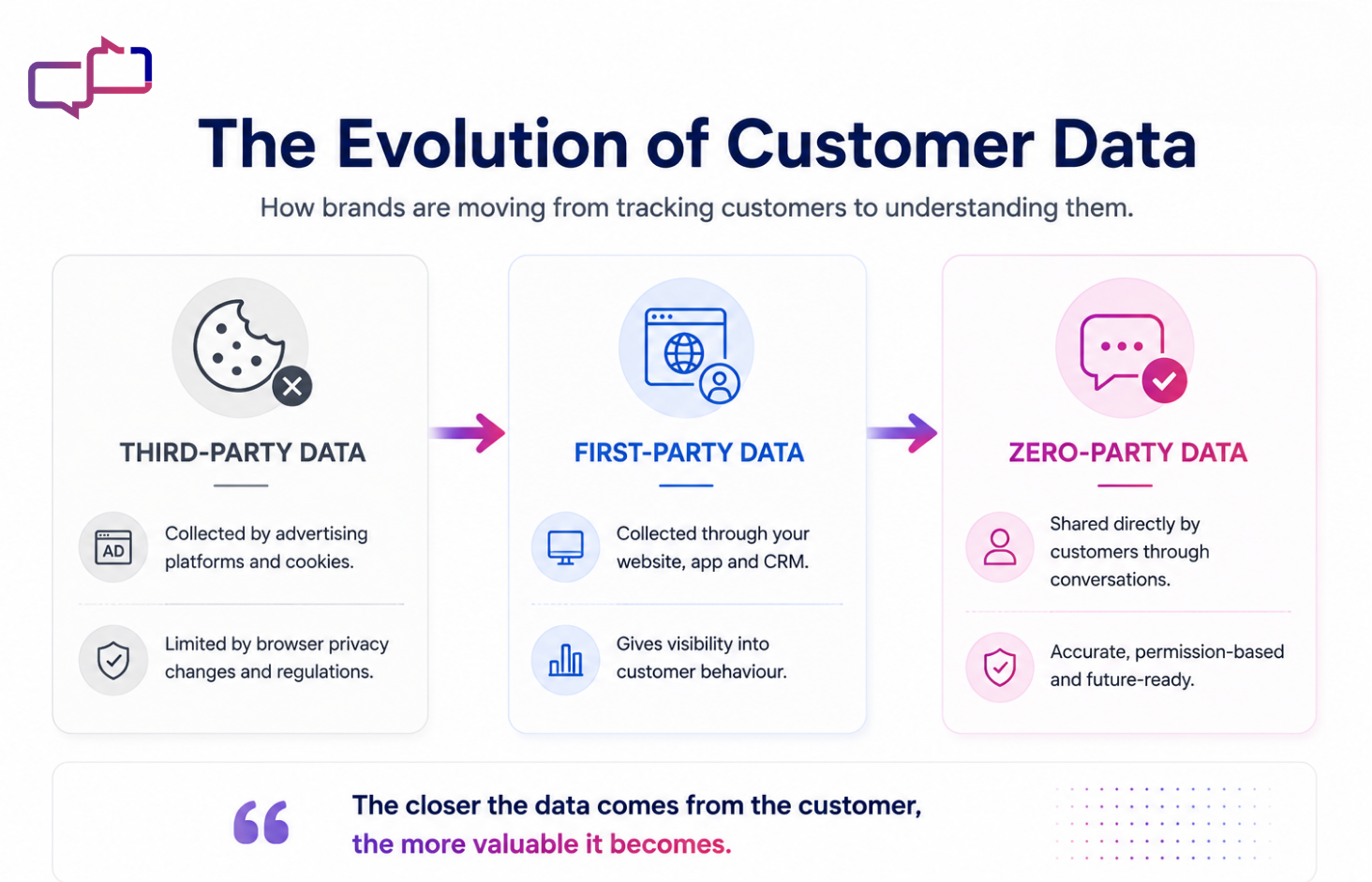
This evolution can be understood in three stages:
Third-Party Data
Information collected by advertising networks and external platforms. Useful for broad targeting, but increasingly limited by privacy regulations and browser restrictions.
First-Party Data
Information gathered from your own website, mobile app or CRM. It includes browsing behaviour, purchase history and customer interactions.
Zero-Party Data
Information customers intentionally choose to share with your business—such as preferences, interests, purchase intentions and communication choices.
Unlike inferred behaviour, zero-party data is accurate because customers tell you exactly what they want.
And that’s becoming incredibly valuable.
Why Conversations Are Replacing Cookies?
Imagine two shopping experiences.
In the first, a customer browses running shoes on your website. Your advertising platform records that behaviour and spends the next two weeks showing them similar advertisements across multiple websites.
You know what they clicked. You don’t know why.
Now imagine something different.
The customer starts a WhatsApp conversation with your brand.
Instead of guessing, you simply ask: “Are you looking for running shoes for the gym, road running or marathon training?”
The customer taps “Marathon Training.”
Within seconds, you’ve learned something far more meaningful than any tracking pixel could tell you.
They told you themselves. That’s zero-party data.
And it isn’t collected through surveillance. It’s collected through conversation.
Why WhatsApp Has Become One of the Most Effective Channels?
Most brands don’t struggle because customers refuse to share information.
They struggle because the process feels like work.
Long registration forms.
Multi-page surveys.
Emails that are never opened.
The more effort required, the fewer customers participate.
Conversational platforms remove that friction.
A customer is already chatting. Answering one or two simple questions feels natural, not transactional.
The result is richer customer insights and better engagement without creating unnecessary barriers.
WhatsApp also offers several practical advantages:
Customers communicate through a verified phone number.
Conversations happen in a familiar environment they already use every day.
Interactive buttons and quick replies simplify data collection.
Businesses can continue the conversation instead of restarting it every time.
The objective isn’t simply collecting data. It’s building a relationship.
What Zero-Party Data Looks Like in the Real World?
Zero-party data isn’t limited to ecommerce.
Every industry can use conversational interactions to better understand customer needs.
Retail
Instead of asking customers to browse hundreds of products, a fashion retailer could ask:
“Are you shopping for workwear, casual wear or occasion wear?”
Every response helps personalise future recommendations.
Healthcare
A diagnostic centre could ask patients how they’d like to receive appointment reminders or report notifications.
The experience becomes more convenient for patients while improving attendance and reducing missed appointments.
Education
An educational institution could ask prospective students which courses interest them most before sharing relevant brochures, webinars or counselling sessions.
Instead of sending generic information, communication becomes personalised from the very first interaction.
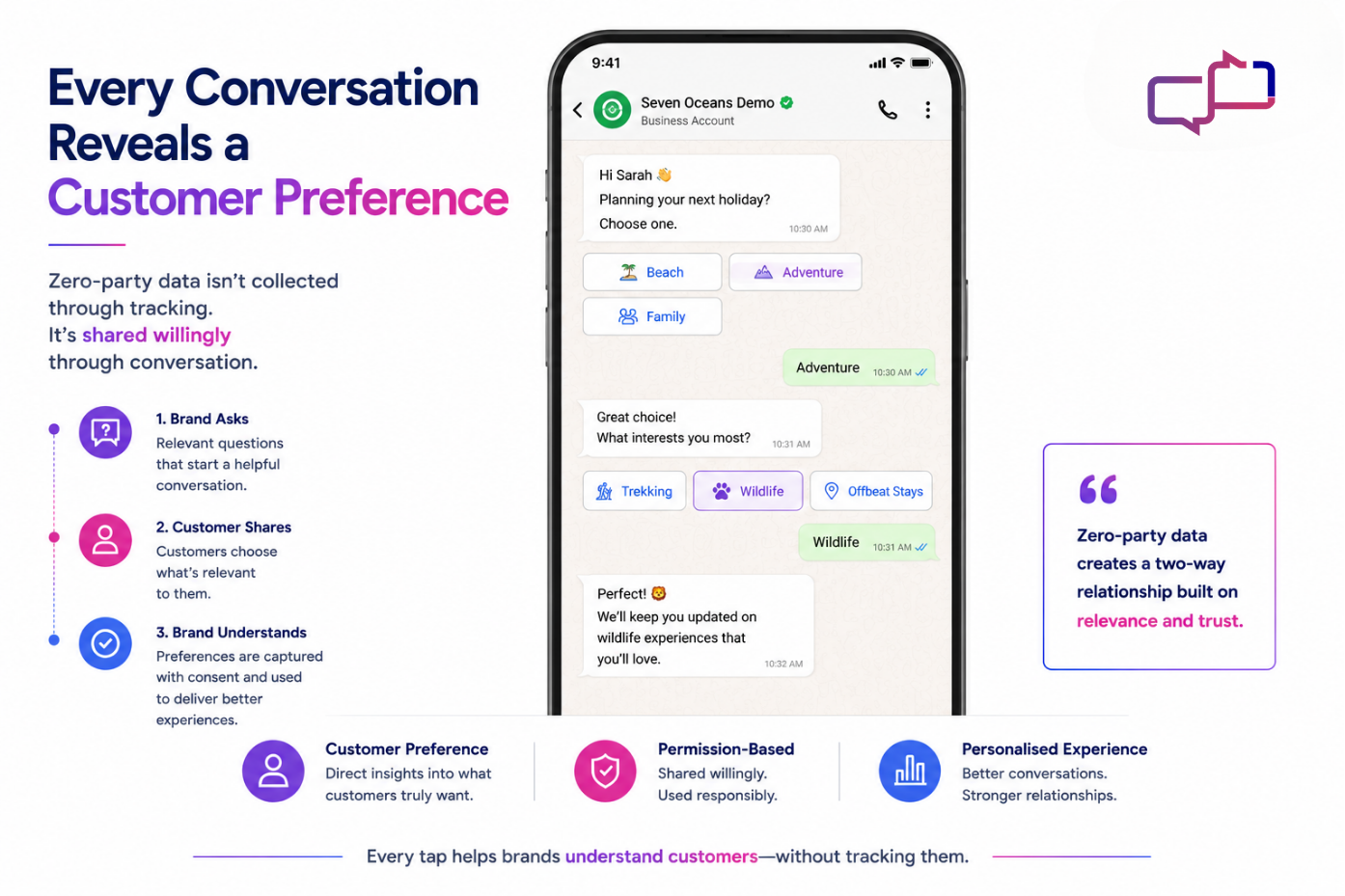
Travel
A travel company could ask customers whether they prefer beach holidays, adventure trips or family vacations.
Future offers become relevant because they’re based on customer preferences, not assumptions.
From Customer Data to Better Customer Experiences
Collecting information is only the beginning.
The real value comes from using it responsibly.
When businesses understand what customers genuinely care about, communication becomes more relevant.
Instead of sending the same promotional message to everyone, brands can send information that matches individual interests.
A customer interested in marathon running receives updates about new running gear.
A parent exploring summer camps receives information about children’s activities.
A traveller who prefers international holidays receives offers that reflect those preferences.
Marketing becomes less intrusive. And significantly more useful.
The Future Belongs to Brands That Own Their Customer Relationships
For years, marketers depended on third-party platforms to understand their audiences.
Tomorrow’s most successful businesses will depend less on rented data and more on direct customer relationships.
Third-party cookies told brands what customers did.
Zero-party data tells brands why they did it.
That difference changes everything.
Privacy isn’t changing the rules of marketing. It’s changing what customers value. The brands that succeed will be those that replace tracking with trust, assumptions with conversations, and rented audiences with lasting customer relationships.
Where Seven Oceans Comes In
At Seven Oceans Teleservices, we help businesses create meaningful customer conversations through WhatsApp Business, SMS, RCS, Voice and Email.
Whether you’re capturing leads, gathering customer preferences, automating engagement or building long-term loyalty, our communication solutions help you turn everyday interactions into valuable customer insights.
Because the future of marketing isn’t about tracking more people.
It’s about understanding them better.
Reading Time: 7 Minutes
Snapshot:
Third-party cookies are disappearing, forcing brands to rethink how they understand and engage customers. Discover why zero-party data, shared willingly through meaningful conversations on channels like WhatsApp is becoming the foundation of privacy-first marketing, stronger customer relationships, and sustainable business growth.Category: Industry Insights
Products
Solution
- Banking & Finance
- Retail & Ecommerce
- Education
- Logistics
- Healthcare
- Entertainment
- Travel & Transport