
With Seven Oceans Teleservices we can make your marketing spend profitable by building relationships, not just transactions. With us, you can focus on tangible outcomes that can foster the growth of your business.
CONTACTS
From "Catalogue Bhejiye" to "Order Confirmed":
How WhatsApp Business API Is Changing the Way Indian Businesses Sell?
18-NOVEMBER-2026
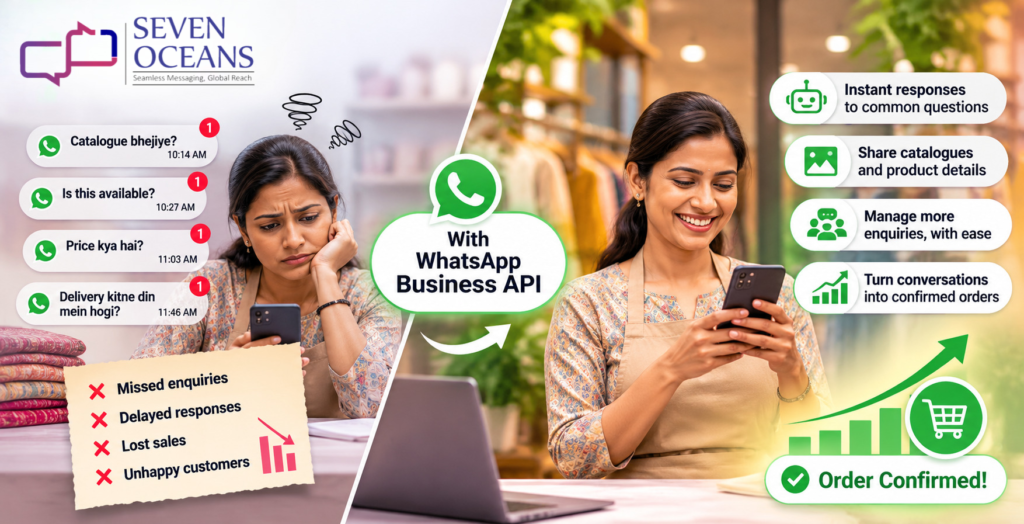
“Price kya hai?”
“Catalogue bhej sakte ho?”
“Available in other colours?”
“COD available hai?”
If you run a business in India, chances are you’ve received these questions on WhatsApp more times than you can count.
From a customer enquiring about a saree to someone checking the availability of a gift hamper, WhatsApp has become an important part of everyday business conversations. Customers are comfortable asking questions, comparing options and seeking recommendations before making a purchase.
For businesses, however, managing these conversations efficiently is a different challenge altogether.
A missed enquiry, a delayed response or a conversation that gets buried under dozens of other messages can mean a lost sales opportunity.
This is where WhatsApp Business API comes into the picture.
As conversational commerce becomes an increasingly important part of India’s digital shopping journey, businesses have an opportunity to use WhatsApp for more than just answering customer queries. They can use it to support product discovery, manage enquiries, automate communication and guide customers towards a purchase.
Let’s look at how.
Indian Customers Don't Always Want to Visit a Website First
Think about how many local businesses operate today.
A customer discovers a boutique through Instagram. Instead of visiting the website, they click the WhatsApp button and ask for the latest collection.
Someone looking for a new refrigerator sees an advertisement and messages the showroom to enquire about pricing, exchange offers and delivery.
A customer planning a wedding contacts a jewellery store on WhatsApp to request product photographs and details.
These are real-world buying situations where the conversation often happens before the purchase.
Customers want quick answers. They want to see their options, understand pricing and get help without navigating through multiple pages.
This shift towards conversational commerce is becoming increasingly relevant in India. A February 2026 retail study by Meta and the Retailers Association of India highlighted WhatsApp’s growing role in product discovery and purchasing journeys.
For businesses, the takeaway is important: customer conversations can be a meaningful part of the sales process, not just a support activity.
The Problem: Too Many Enquiries, Not Enough Time
While receiving enquiries on WhatsApp is easy, managing them as a business grows can become complicated.
Consider a clothing boutique receiving 50–100 enquiries during a promotional campaign.
Customers may ask about:
- Product availability and sizes.
- Prices and ongoing offers.
- Delivery timelines.
- Payment options.
- Return and exchange policies.
- New arrivals and product catalogues.
Now imagine handling every enquiry manually through a single business phone.
Messages get missed. Staff members may respond to the same customer twice. Follow-ups get delayed, and customers who were genuinely interested may move on.
For a business that receives a growing volume of enquiries, relying entirely on manual responses can become difficult to manage.
The challenge isn’t necessarily generating more enquiries. It’s managing the ones already coming in.
How WhatsApp Business API Helps Businesses Manage Conversations
WhatsApp Business API, also known as the WhatsApp Business Platform, gives businesses the ability to integrate WhatsApp messaging with their business systems and communication workflows.
Unlike using WhatsApp only as an individual messaging channel, API-based communication can support structured customer engagement at scale.
Here is how businesses can put it to practical use.
Automate Frequently Asked Questions
Not every customer enquiry needs a sales representative.
Questions about store timings, delivery areas, business hours, product availability or basic service information can often be handled through automated responses.
For example, when a customer messages a clothing store, an automated response could offer options such as:
- View Latest Collection
- Check Product Availability
- Ask About Delivery
- Speak to Our Team
This helps customers find the information they need while reducing repetitive work for the business team.
Share Product Information and Catalogues
Customers often want to see what they’re buying before making a decision.
Businesses can use WhatsApp to share product information, images, catalogues and relevant links.
For example, a furniture showroom can guide customers towards different product categories, while a sweet shop can share its festive gift hamper options.
The easier it is for customers to explore their choices, the easier it becomes for them to take the next step.
Use Interactive Messages
Sometimes a customer needs a little direction rather than another lengthy message.
Interactive WhatsApp messages can include quick reply options and call-to-action buttons, where supported by the approved messaging format.
A customer enquiring about a home appliance, for instance, could be offered options to explore product specifications, request a quotation or speak with a representative.
These small interactions can make the buying journey more organised and convenient.
Manage Customer Follow-ups
A customer who enquires today may not make a purchase immediately.
They might need time to compare products, discuss options with family or check their budget.
Businesses can use appropriate WhatsApp follow-up communication to reconnect with interested customers, share relevant information and answer pending questions.
The key is to make follow-ups useful and timely rather than repeatedly sending promotional messages.
What Does This Look Like for Different Indian Businesses?
The applications of WhatsApp Business API can vary depending on the type of business.
Here are a few everyday examples.
Clothing boutiques and fashion retailers
A customer sees a new collection on Instagram and clicks through to WhatsApp. The business shares the catalogue, answers questions about sizes and availability, and helps the customer place an order.
Jewellery stores
A customer enquires about a particular design. The business shares relevant product photographs, provides information about making charges and helps arrange a store visit.
Sweet shops and gifting businesses
Before a festival or wedding season, customers enquire about bulk orders, packaging options and delivery. Automated responses can help organise common enquiries, while the sales team handles specific requirements.
Electronics and appliance showrooms
Customers enquire about product specifications, exchange offers, warranty details and delivery schedules. WhatsApp can help share product information and direct complex questions to the relevant team.
Education and training institutes
Prospective students request course details, eligibility criteria, fee information and admission dates. Structured messaging and follow-ups can help the admissions team manage enquiries more effectively.
The underlying idea is the same: make it easier for customers to get information and easier for businesses to manage conversations.
Can Automation Replace Human Conversations?
Not entirely, and it shouldn’t have to.
Automation works well for repetitive questions, initial responses and straightforward customer requests. But many buying decisions require a personal conversation.
A customer choosing a wedding outfit may want recommendations. Someone purchasing an expensive appliance may need detailed guidance. A business enquiring about bulk orders may have specific requirements.
This is why a combination of automation and human assistance works well.
An automated system can handle the initial enquiry, collect basic information and direct the customer to the appropriate team member.
The sales representative can then take over when the conversation requires personal attention.
The objective is not to remove the human element. It is to make sure your team spends less time answering the same basic questions and more time helping customers make decisions.
What Should Businesses Consider Before Getting Started?
Before implementing WhatsApp Business API, businesses should think about a few important things.
Define your purpose: Decide whether you want to manage enquiries, automate customer support, run promotional campaigns or integrate WhatsApp with your CRM.
Understand your customer journey: Identify the common questions customers ask and where conversations usually get delayed.
Plan your automation: Start with frequently asked questions and simple response flows. Avoid making the process unnecessarily complicated.
Maintain a human support option: Customers should have a clear way to reach a representative when automation cannot resolve their query.
Follow messaging guidelines: Use approved message templates where required, obtain appropriate customer consent and respect messaging preferences and opt-outs. Relevant WhatsApp Business Platform policies should be followed for all business-initiated communication.
Track results: Monitor response times, enquiries handled, customer interactions and the number of enquiries that eventually convert into sales.
A well-planned WhatsApp communication strategy should make the experience better for both the customer and the business.
From Customer Conversations to Business Opportunities
WhatsApp is no longer just a place where customers ask for product prices or businesses share occasional updates.
For many Indian businesses, it is becoming an important touchpoint throughout the buying journey.
A conversation can begin with a simple product enquiry and lead to a catalogue request, a store visit, a confirmed order or even a repeat purchase.
But making this work consistently requires more than having a WhatsApp number. Businesses need the right messaging infrastructure, automation, integrations and a process to manage customer interactions.
This is where WhatsApp Business API can make a difference.
At Seven Oceans Teleservices Pvt. Ltd., we help businesses get started with WhatsApp Business API, streamline customer communication and explore solutions such as messaging automation, chatbot integration, interactive communication and campaign management.
Whether you’re a growing retail business, an e-commerce brand or an established company handling high enquiry volumes, the objective is to make every customer conversation count.
Because sometimes, the journey from “Is this available?” to “Order confirmed” begins with just one WhatsApp message.
Ready to Make More of Your WhatsApp Enquiries?
Explore WhatsApp Business API solutions with Seven Oceans Teleservices.
Visit www.sevenomedia.com or get in touch with our team to understand how WhatsApp Business API can support your business communication and customer engagement needs.
- Reading Time: 4 Minutes
- Snapshot: Planning your festive marketing campaigns? Discover how to use SMS, WhatsApp, RCS and Voice effectively with our Festive Messaging Cheat Sheet. A practical resource to help marketers and businesses plan smarter campaigns and drive better customer engagement.
- Category: Marketing & Customer Engagement
Products
Solution
- Banking & Finance
- Retail & Ecommerce
- Education
- Logistics
- Healthcare
- Entertainment
- Travel & Transport